Designing Interfaces That Feel Effortless
The best user experiences are rarely noticed. They guide behavior quietly, reduce friction naturally, and make complexity feel simple.
9 min read
UX
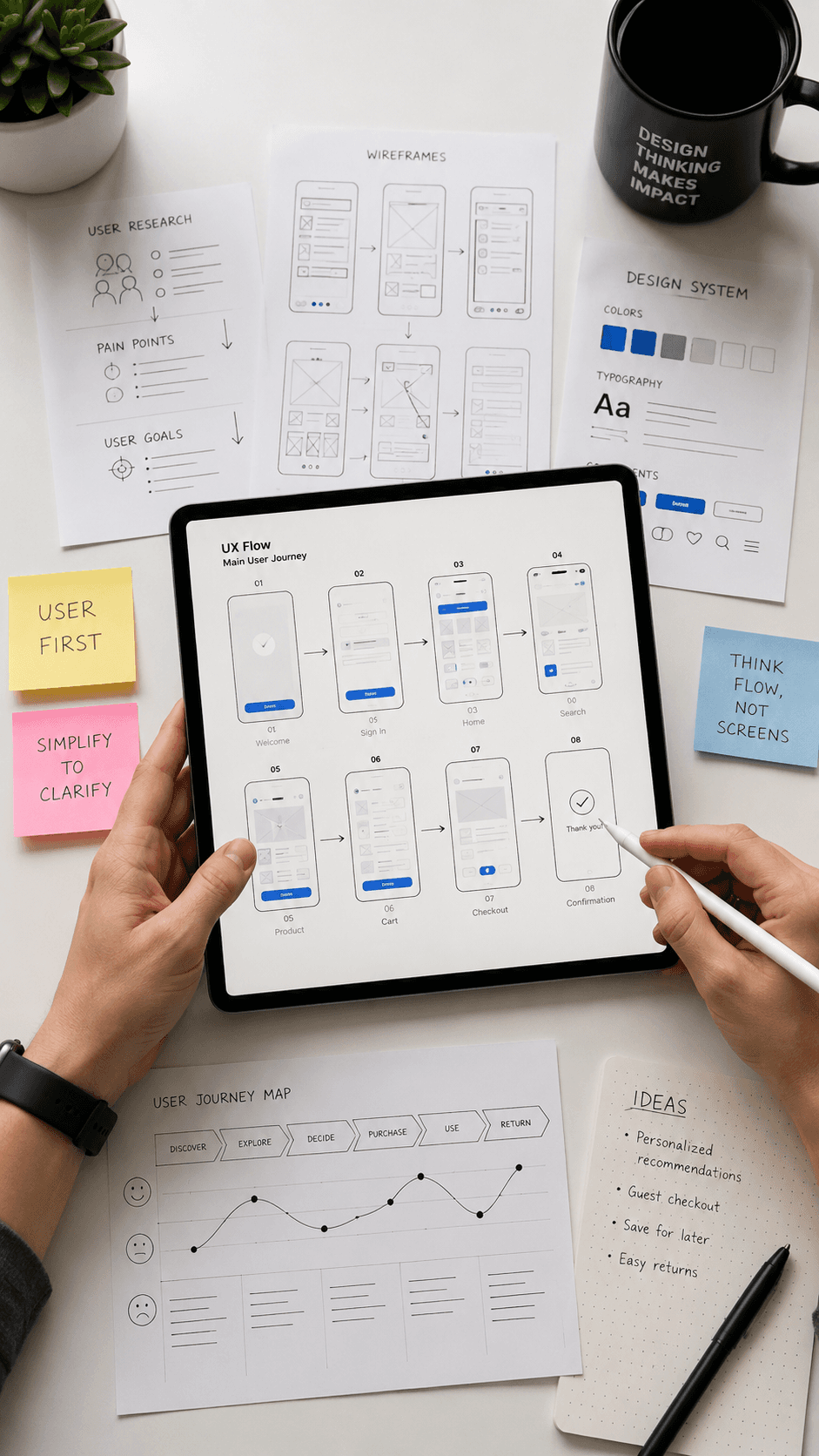
Users Decide Faster Than Designers Expect
People do not interact with interfaces logically first. They react emotionally first.
Within seconds, users begin forming assumptions about clarity, trust, usability, and effort. If an interface feels confusing, heavy, or unpredictable, confidence disappears before engagement truly begins.
Good UX reduces uncertainty immediately.
The goal is not to impress users with complexity.
It is to help them move forward without hesitation.
Clarity Is the Foundation
An intuitive experience begins with clear hierarchy.
Users should instantly understand where to look, what matters most, and what action comes next. Strong spacing, typography, contrast, and structure guide attention naturally without requiring conscious effort.
When hierarchy fails, everything begins competing for attention simultaneously.
That is when interfaces start feeling exhausting instead of useful.
Great UX Reduces Cognitive Friction
Every interaction carries mental effort.
Users constantly process decisions, interpret signals, and predict outcomes while navigating a product. Poor UX increases that cognitive load unnecessarily through inconsistent patterns, unclear labels, overloaded screens, or unpredictable behaviour.
Strong UX removes that burden quietly.
Navigation feels predictable
Interactions feel familiar
Feedback feels immediate
Actions feel reversible
Information feels prioritised
The smoother the experience becomes, the less users need to think about the interface itself.
“An interface feels intuitive when the user never has to stop and question it.”
Familiarity Creates Confidence
People learn digital products through patterns.
That is why consistency matters so deeply in UX design. Familiar behaviours reduce learning time and create confidence during interaction. Users should not have to relearn basic mechanics on every screen.
Innovation is valuable, but unnecessary reinvention often creates friction instead of improvement.
The strongest interfaces balance originality with recognisable behaviour.
Simplicity Is Not the Absence of Depth
Minimal interfaces are often misunderstood as simple to create.
In reality, simplicity requires more intentional thinking than complexity. Every unnecessary element removed demands stronger prioritisation underneath.
Good UX is not about removing functionality.
It is about removing confusion.
That distinction changes how products are designed entirely.
Invisible Systems Shape Great Experiences
Behind every intuitive interface is a system users never see directly.
Spacing logic, interaction rules, feedback states, accessibility considerations, motion principles, and behavioural consistency all contribute to how effortless a product feels.
When these systems align properly, the experience becomes seamless.
The interface fades into the background.
The outcome becomes the focus.
“The best interfaces guide attention without demanding it.”
UX Is a Trust-Building Discipline
Users associate clarity with reliability.
When interactions feel stable and understandable, products appear more trustworthy. Small details such as response timing, button states, transitions, and error handling shape perception more than most teams realise.
Poor UX creates hesitation.
Strong UX creates momentum.
That momentum directly affects retention, engagement, and long-term product perception.
The Goal of an Intuitive Product
The highest level of UX design is not decoration.
It is reduction.
Reducing friction.
Reducing uncertainty.
Reducing unnecessary effort.
When users can achieve their goals naturally, the product begins to feel obvious in the best possible way.
And that is usually the moment good design disappears entirely.

